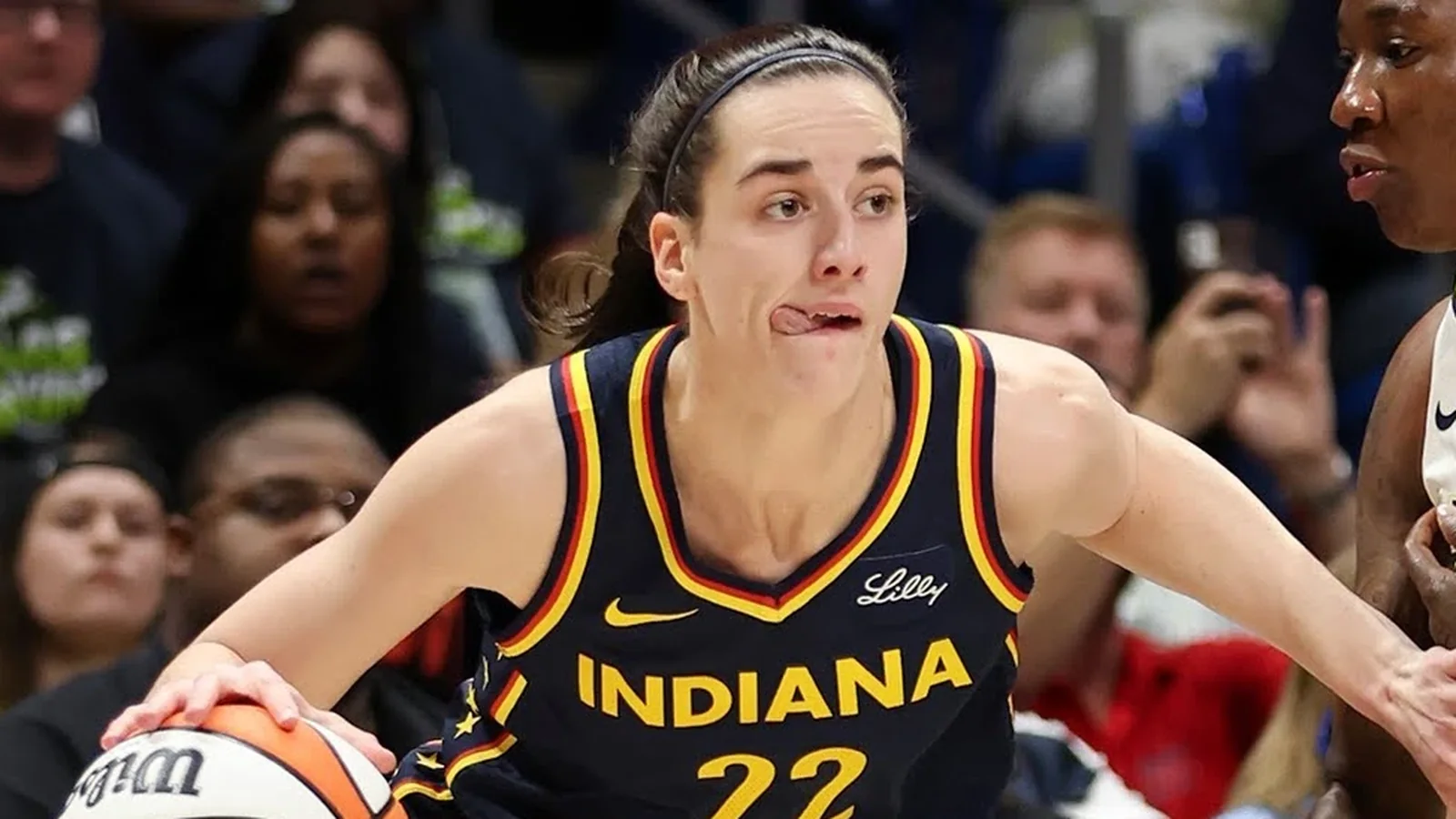
Here is the stat that starts a thousand arguments. Type "Caitlin Clark three point percentage" into a search bar and you get a number that looks almost ordinary: 34.4% as a rookie, 27.9% in an injury-wrecked 2025, 36.1% in 2026. Across three WNBA seasons she sits at roughly 34%, which is right around where the league as a whole tends to land.
And yet coaches game-plan for her from the half-court logo, defenders pick her up 30 feet from the basket, and plenty of people who watch the sport for a living call her one of the best shooters the women's game has produced. Both things are true. The catch is that three-point percentage, on its own, measures the wrong thing for a player like Clark. Let's take the number apart.
2024: 122 of 355 (34.4%), a rookie record for made threes and the most attempts in the league.
2025: 27.9% on about 8 attempts a game, in 13 games before groin and ankle injuries ended her season.
2026: 114 of 316 (36.1%) in 40 games, alongside 22.3 points and 8.3 assists a game.
Career: about 265 of 775, or 34.2%.
What the raw number says (and what it hides)
Three-point percentage answers one narrow question: of the threes you took, how many went in? It does not ask how hard those shots were, how many of them anyone else on the roster could have taken, or what happened to the rest of the floor while you were taking them.
For a spot-up specialist who waits in the corner for a kick-out pass, that narrow question is almost the whole story. Their shots are similar from night to night: open, set feet, about 22 feet from the rim. Compare two such shooters by percentage and you learn a lot.
Clark is not that player. She is the primary ball-handler, the main playmaker and the first name on every opposing scouting report. A large share of her threes come off the dribble, early in the shot clock, from well beyond the line, often with a defender already draped over her. Judging those shots by the same yardstick as a catch-and-shoot corner three is like grading a quarterback's deep balls against a running back's check-downs.
The distance problem: her threes are not the league's threes
The most obvious adjustment is range. Shot-tracking numbers from her rookie season showed something unusual: her accuracy went up as the shot got longer. Per the team-shared data reported by Sports Illustrated, she shot about 28.9% from 20 to 24 feet, 33.1% from 25 to 29 feet and 37.5% (15 of 40) from 30 to 34 feet.
Trackers differ on the exact figure, but most put her average three-point attempt at roughly 27 feet, the deepest in the league and among the deepest the WNBA has recorded. The standard WNBA three-point line sits at 22 feet 1.75 inches at the top of the key. In other words, a big slice of her attempts come from a distance where most of the league does not shoot at all.
| Shot distance (2024) | Clark 3P% | What it tells you |
|---|---|---|
| 20-24 ft | 28.9% | Closer threes were her weak spot as a rookie |
| 25-29 ft | 33.1% | Near league-average accuracy from well beyond the line |
| 30-34 ft | 37.5% (15 of 40) | Elite on shots most players never attempt |
Range matters for more than style points. A shot from 30 feet forces a defender to step out to 30 feet, which is where the second part of the story begins.
Gravity: the points that never show up in her shooting line
"Gravity" is the word coaches use for the pull a shooter exerts on the defense. When a defender has to meet Clark at the logo, the floor behind that defender gets enormous. Help defenders have to choose between leaving their own player and conceding a lane to the rim. Screens set 30 feet out create switches and two-on-ones that a normal pick-and-roll never would.
That attention is why her assist numbers are so large. In 2026 she averaged 8.3 assists to go with 22.3 points, and the Fever say she became the first player in WNBA history to post 800 points and 300 assists in a single season (891 and 333, per Bleacher Report's season wrap). She was named to the All-WNBA First Team.
None of that shows up in three-point percentage. A missed 30-footer that made two defenders turn their heads can still be the reason a teammate's layup was uncontested two possessions later. Her shooting creates offense whether the ball goes in or not, which is the real definition of a great shooter at the highest level of the sport.

- Prop builder
- Live betting
- Same-game parlays
Points per shot: why 36% from three beats 50% from two
The fairest way to compare shots is points per attempt. A three is worth 1.5 times a two, so the break-even maths is simple:
- 2026, 36.1% from three: 0.361 × 3 = about 1.08 points per attempt. To match that on two-pointers you would need to shoot about 54%.
- 2024, 34.4% from three: 0.344 × 3 = about 1.03 points per attempt, the same as hitting about 52% of twos.
- 2025, 27.9% from three: about 0.84 points per attempt. That season was genuinely poor, played through a run of soft-tissue injuries.
Even her "average" seasons turn threes into an efficient shot, and she does it at volume. Her 355 attempts as a rookie led the league, and 122 makes set a WNBA rookie record. Being the player the defense is built to stop and still producing more than a point per three-point attempt is a much harder trick than posting 40% on four open catch-and-shoot looks a night.
It also explains the team-level effect. A guard who can punish a defense from 30 feet raises the efficiency of everyone else, because every shot inside that range gets a little easier. That value lives in team offensive ratings and teammates' shooting numbers, not in her own percentage.
Small samples: why one season's 3P% can mislead
WNBA seasons are short. Clark's 316 three-point attempts in 2026 sound like a lot, but percentages from samples that size swing more than most fans expect.
A quick worked example. If a shooter's true talent were exactly 36.1%, the standard error over 316 attempts is the square root of (0.361 × 0.639 ÷ 316), or about 2.7 percentage points. A rough 95% range is plus or minus 5.3 points: anything from about 30.8% to 41.4% would be an unremarkable season for that same shooter.
That is why her 27.9% in 2025 should not be read as a collapse, nor her 36.1% in 2026 as a breakout. The 2025 number came from just 13 games and about 104 attempts, played through quad, groin and ankle problems that kept her out after mid-July and ended her season. Her three-year mark of about 34.2% on 775 attempts is the better guide, and it is still a noisy one.
The college résumé that built the reputation
The "greatest shooter" label did not come from nowhere. At Iowa, Clark finished as the NCAA Division I career leader in made threes with 548 and set the single-season record with 201 in 2023-24, per Fox Sports. No Division I player, men's or women's, had come close to 200 threes in a season before her.
Those records are about volume and range as much as accuracy. She took and made shots from distances college defenses had never had to guard, and she did it as the focal point of every opponent's game plan. The WNBA version is the same player facing bigger, faster, more physical defenders, which is exactly why her percentage dropped to "normal" while her impact did not.
So is she overrated as a shooter?
Not really. The fair verdict has three parts:
- She is not the most accurate three-point shooter in WNBA history. A career mark around 34% will not top any percentage leaderboard, and she has had cold stretches, including well-documented road slumps.
- She is one of the most dangerous shooters the women's game has seen. Range, volume and off-the-dribble creation change how defenses play, and that matters more than a few percentage points.
- Her shooting value shows up elsewhere. Look at assists, team efficiency and teammates' open looks, not only the 3P% column.
If you want a single shooting number for Clark, true shooting percentage or points per shot attempt tells you far more than three-point percentage. If you want to understand her, watch where the defenders are standing when she crosses half court.
What it means if you bet on Clark
For bettors, the distinction is practical. Sportsbooks rarely offer three-point percentage props. They offer made threes, points, assists and combinations, and those markets reward volume.
Take a made-threes line of 2.5, so you need 3 or more to win the over. Using her 2026 rate of 36.1% and treating each attempt as independent:
| Three-point attempts | Expected makes | Chance of 3+ makes |
|---|---|---|
| 6 | 2.2 | 37% |
| 7 | 2.5 | 49% |
| 8 | 2.9 | 60% |
| 9 | 3.2 | 69% |
The swing from 6 to 9 attempts is far bigger than any realistic change in her accuracy. So the real handicapping questions are about volume: Is she healthy? Is the game expected to be fast and high-possession? Is a key teammate out, which pushes more shots her way? A favourite priced at -150 implies a 60% chance (use our odds converter to check any price), so the over at 2.5 is only worth it if you expect more than 8 attempts.
Two more reminders. Shooting is streaky over small samples, so do not chase a hot or cold week. And always compare the same prop at two books: a half-point difference on a made-threes line is worth more than most "trends". Our guides to live betting and parlays explain how to use props without overloading a ticket, and the Rick Barry free throw story is another reminder that the "obvious" shooting stat is not always the one that matters.
Where to bet on the WNBA
The WNBA returns next spring, and player props open up as the season approaches. These are the books we would use for WNBA markets, with MyBookie our first choice:



Menus vary by book and by game, so check the WNBA section close to tip-off for the props on offer.
Legal and tax notes
Offshore sportsbooks are licensed outside the US and are not regulated by any US state, so your own state's law decides what is allowed where you live, and several states have taken action against offshore operators. Gambling winnings are taxable income in the US, and from 2026 itemizers can deduct only 90% of their losses.
18+ (21+ where required). Bet only what you can afford to lose, and see our responsible gambling page if betting stops being fun.