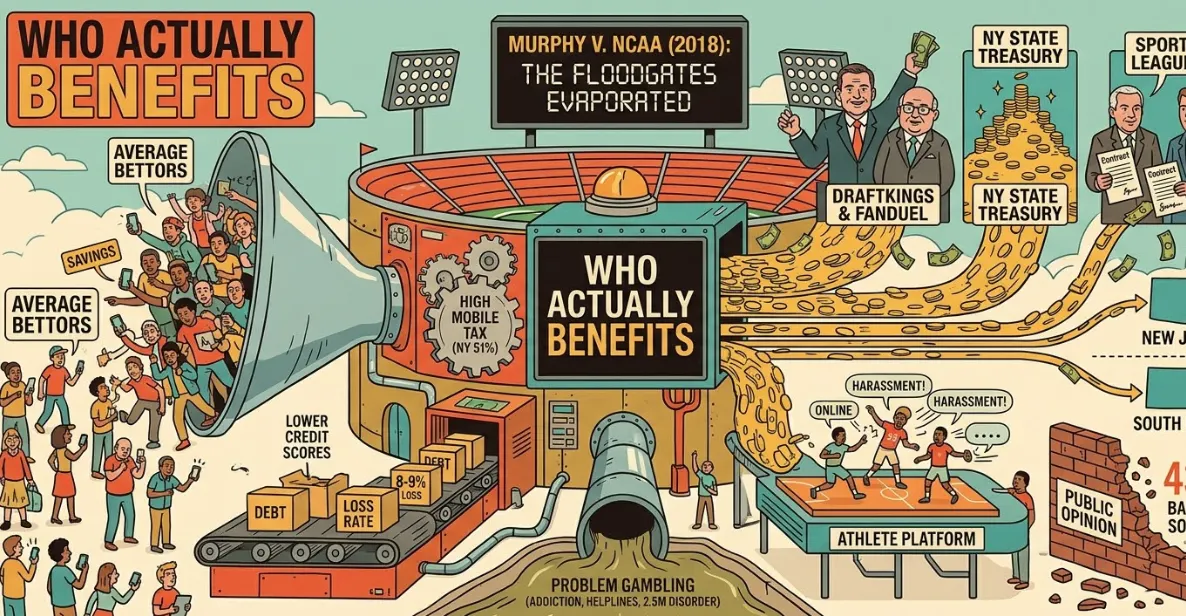
Eight years ago, the Supreme Court ripped the lid off American sports betting. The Professional and Amateur Sports Protection Act, a federal ban that had kept legal single-game wagering locked inside Nevada since 1992, was struck down in May 2018. The decision was called Murphy v. NCAA. It passed 6 to 3. Justice Alito wrote the opinion. And the floodgates did not just open. They evaporated.
By 2025, Americans had legally wagered $165 billion on sports in a single year. That is not a typo. One hundred and sixty-five billion dollars pushed through apps, kiosks, and sportsbook counters in twelve months. The industry generated $16 billion in gross revenue and handed $3.7 billion to state treasuries in taxes.
Those are the billboard numbers. They look great in a press release. But they raise an obvious question that nobody running a Super Bowl commercial is eager to answer: who actually benefits from all of this?
Our own Sportsbooks Hank, editor-in-chief Hank Broinowski, spent weeks pulling the threads on that question. The result is a full-length investigative report, "Legalized Sports Betting in America: Who Actually Benefits?", now published and free to read. It runs ten pages, cites two dozen sources including federal data, peer-reviewed studies, and state regulatory filings, and it does not pull punches.
Here is what he found.
The Money Is Real. The Distribution Is Lopsided.
New York alone collected $1.3 billion in sports betting taxes in 2025. That is 36 percent of every sports betting tax dollar collected nationwide, from a single state. The reason is simple: New York charges operators a 51 percent tax on gross gaming revenue, the highest rate among major markets. Illinois came in second at $480 million, using a graduated tax structure that tops out at 40 percent.
Meanwhile, New Jersey, the state that literally brought the Supreme Court case that made all of this possible, has collected just $674 million in total since 2018. Seven years of legal betting. Its tax rate sits between 13 and 14.25 percent. The state that fought the fight got a fraction of the reward.
South Dakota? $323,202. Total. Because sports betting there is restricted to eight casinos in Deadwood and a handful of tribal properties. No mobile. No apps. No scale.
The report lays this out state by state, and the pattern is clear: states with open mobile markets and high tax rates capture enormous value. States with restricted access or monopoly models get table scraps.
The Operators Are Playing a Familiar Game
DraftKings and FanDuel together control over 70 percent of the U.S. market. In every state with an open market, the top five operators hold at least 82 percent of handle. In Michigan, where fourteen operators compete, the top five still own 90 percent.
Building that dominance cost a fortune. FanDuel's parent company Flutter Entertainment has spent over $1 billion annually on marketing. DraftKings burned through $399 million on marketing and sales in the first half of 2022 alone. The entire sports betting category spent $416 million on television advertising in 2024, and that does not count digital, streaming, social, radio, or the promotional bonuses dangled in front of every new customer.
The playbook is straight from Silicon Valley: spend wildly to acquire users, eat losses for years, bet that scale will eventually deliver profitability. FanDuel managed a profitable quarter in mid-2022. Several smaller operators, unable to compete at that spend level, have quietly exited. Unibet, Betway, and SuperBook all pulled back from U.S. markets.
And the leagues that once sued to prevent legalization? They are now cashing checks. The NFL signed sportsbook partnership deals worth a combined $1 billion with FanDuel, Caesars, and DraftKings. The same organizations that argued in federal court that legal betting would corrupt their games now plaster sportsbook logos across their broadcasts and sell official data feeds to the companies taking bets on their players.
The Average Bettor Is Not Winning
This is the part of the story that gets buried under the confetti.
Sportsbooks kept 9.7 percent of all money wagered in 2025, the highest annual win rate on record. During football season, the average bettor loses between 8 and 9 percent of what they put down. That translates to roughly $133 to $209 in losses per person, per season.
A UC San Diego study that tracked over 700,000 individual gambling accounts found that 96 percent of tracked gamblers appeared to lose money. And the industry's revenue is not spread evenly across its customer base. Account-level data shows that roughly 80 percent of sportsbook revenue comes from just 5 to 7 percent of customers. The heaviest users, who bet the most and lose the most, are the ones keeping the lights on.
Hank's report also digs into what happens to the money that goes into betting accounts. Research from UCLA and USC found that legal online sports betting was associated with lower credit scores and higher bankruptcy rates. A separate study found that each dollar deposited into a sports betting account reduced net investment in brokerage accounts by nearly the same amount. The money is not coming from lottery budgets or entertainment spending. It is coming from savings.
Problem Gambling Is Not a Footnote
A study published in JAMA Internal Medicine found that internet searches for gambling addiction help increased 23 percent nationally after the Murphy decision. In Illinois, the spike was 35 percent. In Michigan, 37 percent. At peak, 180,000 Americans were searching for gambling addiction help every month.
Maryland's statewide prevalence study, the first conducted after mobile betting launched there, found disordered gambling rates among adults rose from 4 percent in 2022 to 5.7 percent in 2024. Two-thirds of those affected were male. The report found that affected individuals were disproportionately Black or African American, Hispanic or Latino, less educated, and unmarried.
The National Council on Problem Gambling puts it bluntly: the rate of gambling problems among sports bettors is at least twice as high as among other types of gamblers. An estimated 2.5 million Americans experience severe gambling disorder, with another 4 to 6 million at elevated risk.
And the spillover effects go beyond the individual. Research has linked sports betting legalization to a 20 percent increase in mass-market alcohol consumption, a 75 percent jump in gambling helpline calls, and measurable increases in domestic violence reports following upset NFL losses in states with legal betting.
Athletes Are Paying a Price Too
At least 20 professional athletes across the NFL, MLB, NBA, NHL, and MLS have faced disciplinary action for gambling violations since 2018. Two received permanent bans in 2024 for betting on their own teams. More than half of the disciplined athletes were NFL players.
But the less-reported story is harassment. An NCAA survey found that over a third of Division I men's basketball players experienced betting-related harassment. The Women's Tennis Association reported that more than 40 percent of all online abuse directed at players came from gamblers. When a bettor loses money on a player's stat line, some of them let that player know about it. Loudly.
Public Opinion Is Turning
Here is a number that should worry the industry: 43 percent of Americans now say legal sports betting is bad for society, up from 34 percent in 2022. Among men under 30, a core demographic for sportsbooks, that figure jumped from 22 percent to 47 percent in three years.
The early enthusiasm is fading. The ads are not going away, but the novelty has worn off, and the consequences are becoming harder to ignore.
Read the Full Report
Everything above is a summary. Hank's full report goes deeper into the regulatory patchwork, the prediction market threat, the Illinois tax surcharge fiasco, the DC monopoly debacle, and the math behind the house edge. It is ten pages, fully sourced, and written for people who want to understand the industry rather than be marketed to by it.
Read "Legalized Sports Betting in America: Who Actually Benefits?" on Issuu
If the numbers in this piece surprised you, the full report will keep you busy for a while.