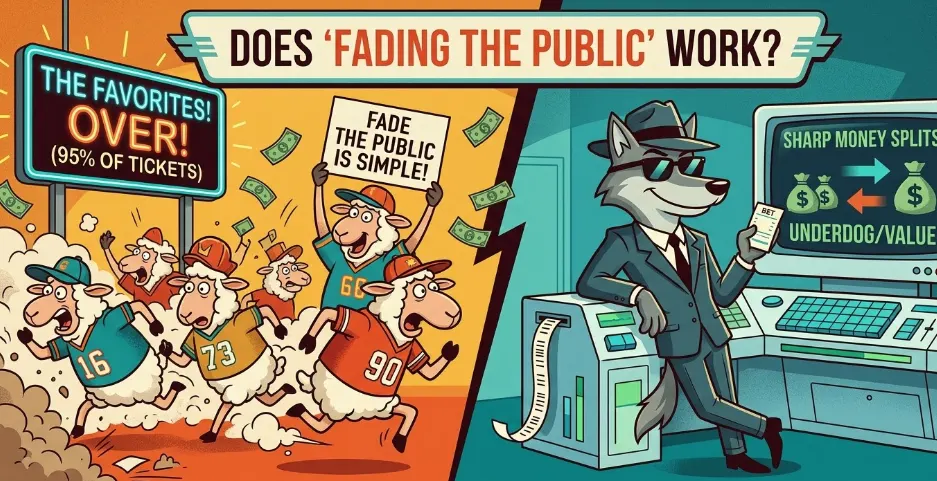
Walk into any sports bar on a Sunday morning, and you are guaranteed to hear it. Some guy nursing a lukewarm light beer will lean over, tap the bar top, and deliver the oldest piece of gambling advice in the book: "Just fade the public, bro. Vegas always wins."
It sounds brilliant in its simplicity. If the average sports bettor loses money over the long haul, then betting the exact opposite of the average sports bettor should make you a millionaire, right?
Not exactly. In fact, if you blindly employ this strategy in today's highly efficient, tech-driven betting markets, you are taking a fast track to a zeroed-out bankroll. The sports betting landscape has mutated. The old-school strategy of automatically betting against the masses is no longer the silver bullet it used to be. Here is why the old adage needs an upgrade, and how you can actually find value in public betting data today.
The Myth of the Balanced Book
To understand why "fading the public" is largely a relic of the past, we have to look at how people think sportsbooks operate versus how they actually operate.
The common misconception is that sportsbooks act like impartial brokers. The theory goes that oddsmakers want exactly 50% of the money on Team A and 50% of the money on Team B. That way, they pay the winners with the losers' money and pocket the 10% "vig" or juice. If the public heavily bets on Team A, the book moves the line to encourage bets on Team B.
Here is the truth: modern market-making sportsbooks do not care about perfectly balanced scales.
Major oddsmakers are entirely comfortable taking a massive position on a game if they trust their numbers. They do not move betting lines just because 80% of recreational players bought tickets on the Dallas Cowboys. They move lines based on who is betting, not just how much is being bet. If ten thousand casual fans bet $20 on the favorite, the book barely blinks. If one respected betting syndicate drops a calculated, high-limit wager on the underdog, the bookmakers instantly adjust the line.
The Mathematical Trap of the Blind Fade
Let us look at the cold, hard statistics. Over the last decade, tracking data has shown that if you blindly fade the public (betting against any team receiving 70% or more of the public tickets), your win rate will hover right around 50%.
You might be thinking that breaking even is not so bad. But in sports betting, a 50% win rate against standard -110 odds is a guaranteed loss. To break even, you need to hit 52.38% of your bets. To actually make a profit, you need to be hitting 54% or higher. Fading the public blindly simply generates a coin-flip win rate while the sportsbook slowly bleeds you dry through the vigorish.
The public is not always wrong. Sometimes, the heavy favorite is genuinely just that much better. Think about betting against Patrick Mahomes when he is an underdog. The public absolutely loves betting on Mahomes, and for good reason. He covers the spread as an underdog at an overwhelmingly high percentage. If you faded the public and bet against him in those spots just to be contrarian, your wallet would be incredibly light right now.
How to Use Public Data the Right Way
So, should you completely ignore public betting percentages? Absolutely not. The data is incredibly valuable if you know how to read the matrix. Instead of looking at total tickets, you need to look at the Ticket vs. Money Split. This is where the real edge lives.
Here is how you execute it:
-
Identify the Square Action: Look for a game where one team is receiving a massive percentage of the total bets (the tickets). Let us say 75% of the total betting slips are on the Los Angeles Lakers. This tells you the casual public loves LA.
-
Follow the Sharp Money: Now, look at the percentage of the total money (handle) wagered on the game. If the Lakers have 75% of the tickets but only 40% of the money, alarm bells should ring.
-
Do the Math: If 25% of the bettors are responsible for 60% of the cash, it means the bets on the opponent are significantly larger. This is the footprint of "sharp" money or professional bettors.
This scenario creates what is known in the industry as Reverse Line Movement. If the Lakers open as 7-point favorites, get 75% of the tickets, but the line magically drops to Lakers -5.5, the sportsbook is telling you a story. They are lowering the line to reduce their exposure because respected, high-dollar players are hammering the underdog. That is when you fade the public. You do not fade them blindly; you fade them when the professional money tells you to.
What We Learned
Today's average bettor is significantly smarter than the bettor from twenty years ago. With access to advanced analytics, injury updates on social media, and line-shopping tools, the "public" is no longer a herd of blind sheep.
Fading the public is not a betting strategy on its own. It is a secondary indicator. Use public betting percentages to spot inflated lines, identify overreactions to breaking news, and track where the heavy professional money is flowing. If you treat contrarian betting as a piece of the puzzle rather than the entire playbook, you will find yourself on the right side of the counter much more often.