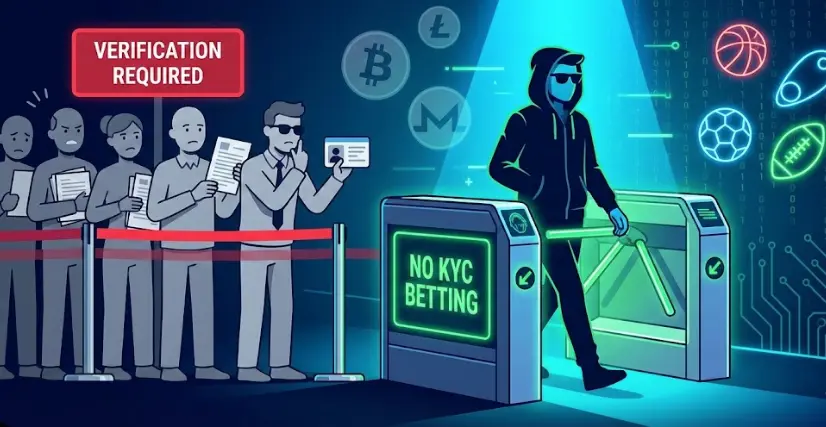
"No KYC" is one of the most searched phrases in crypto betting and one of the most misunderstood. Plenty of sportsbooks will let you sign up with an email address and fund your account with crypto. Far fewer will promise you will never be asked for ID, and the ones that do promise it can change their minds the moment you try to withdraw a big win.
This page is the honest version. Below are the crypto sportsbooks that, according to their terms and independent reviews, let you register and bet without uploading documents, followed by exactly when verification can still happen, what anonymous betting does and does not protect you from, and how to avoid the frozen-withdrawal stories that fill betting forums.
Crypto sportsbooks that do not ask for ID at sign-up:



What "no KYC" actually means
KYC stands for Know Your Customer: the identity checks (a passport or driving licence, sometimes a proof of address or a selfie) that regulated financial and gambling businesses run on their customers. A no-KYC sportsbook is one that does not require those documents to open an account, deposit or place bets. Typically you need an email address and a password, and you deposit cryptocurrency.
What it does not mean:
- It is not a guarantee. Every one of these operators keeps the right to ask for identity documents, especially before a large withdrawal or if its fraud checks flag an account.
- It is not invisibility. The sportsbook still sees your IP address, device and betting history, and every on-chain deposit and withdrawal is recorded permanently on a public blockchain.
- It is not a licence to ignore the rules. Each site lists countries it does not accept. If you are in one of them, the site can void your bets and keep your balance, and no ID check is needed for that.
No KYC sportsbooks compared
As of November 16, 2026, based on each operator's published terms and independent reviews. Terms change; read the current ones before you deposit.
| Sportsbook | ID at sign-up | Verification before withdrawal | US players |
|---|---|---|---|
| Sportbet.one | No documents, per reviews | Email verification required; documents can still be requested | Accepted, per reviews |
| WolfBET | No documents, per reviews | Email confirmation and 2FA; KYC reported for large withdrawals or flagged activity | Not accepted |
| BetCoin.ag | No documents, per reviews | Extra checks reported on payouts over 1 BTC | Not accepted |
For comparison, the big US-facing offshore books do verify. MyBookie, XBet, BUSR and BetUS all say they check ID before paying out, and Bovada says ID may be required and asks for a form for each credit card you have used before you withdraw. If you are in the United States, Sportbet.one is the only book on this page that reviews say accepts you, and Michigan's regulator has reportedly named it among offshore operators it sent cease-and-desist orders to in 2026.
When verification can still happen
No operator in this market publishes a threshold below which it will never ask for ID, so ignore any site that tells you "withdraw up to $X with no KYC". These are the triggers reviewers and players report most often:
- Large withdrawals. A cash-out far bigger than your usual deposits is the most common trigger. BetCoin, for example, is reported to apply extra checks above 1 BTC.
- Location mismatches. Logging in from a country on the restricted list, or from many different locations, is grounds for a review and for voided bets.
- Bonus abuse and multiple accounts. Opening several accounts to claim a welcome bonus more than once is the fastest way to get every account frozen.
- Anti-money-laundering checks. Depositing and withdrawing without really betting looks like money moving through the site, not someone betting, and operators are expected to act on it.
The practical lesson is boring and effective: bet from a country the site accepts, use one account, read the bonus terms before you accept a bonus, and expect that a life-changing win may come with a request for documents. If that would be a deal-breaker, find out before you deposit, not after you win.
Why bettors choose crypto sportsbooks without KYC
There are legitimate reasons to prefer a sportsbook that asks for less:
- Less personal data stored. Every passport scan held by an offshore company is a data breach waiting to happen. Sharing less is a reasonable privacy choice.
- Faster start. Sign-up takes minutes and there is no waiting for a document review before your first withdrawal.
- Crypto payouts. Blockchain transfers do not wait for banking hours, though the sportsbook's own approval process still does.
And honest reasons for caution:
- Weaker recourse. These operators are licensed offshore. If a withdrawal is refused, there is no US regulator to complain to, and player complaints about withheld winnings exist for several crypto books, including some on this page.
- Licence quality varies. Some licences are hard to verify on any public register. Treat a licence as a minimum, not a guarantee.
- Taxes still apply. Anonymity at the sportsbook does not change your tax position. In the US, gambling winnings are taxable income, whether or not you receive a form.
How to choose a no KYC betting site
- Check the restricted countries first. If your country is on the list, stop there. Betting from a restricted country is the surest way to have winnings voided.
- Read the withdrawal section of the terms. Look for minimums, maximums per day or week, and any language about verification "at the operator's discretion".
- Test with a small withdrawal. Deposit a modest amount, place a few bets, and withdraw. How a site handles $100 tells you a lot about how it will handle $10,000.
- Use coins you understand. Stablecoins avoid price swings while your money sits in an account. Always copy withdrawal addresses carefully: a crypto transfer to the wrong address cannot be reversed.
- Keep your own records. Screenshots of bet slips, deposits and withdrawals are your only evidence if a dispute starts.
Speed matters too. Our guide to the fastest payout betting sites compares each book's stated withdrawal times, and sportsbooks that do not limit winners covers what happens after a winning streak. For stablecoin betting specifically, see our USDT betting guide.
Is anonymous sports betting legal?
It depends on where you live, and this is not legal advice. The sportsbooks on this page are licensed outside the countries they serve and are not regulated by US state gaming authorities. In the US, several states have sent cease-and-desist letters to offshore operators in 2025 and 2026. Some countries, including several in the Middle East and Asia, prohibit online gambling entirely. If online betting is illegal where you live, a no-KYC sportsbook does not make it legal, and you should not use one.
We do not recommend using a VPN or any other tool to get around a sportsbook's country restrictions. It breaks the operator's terms, it is a common reason for winnings to be voided, and it may break local law.
Bet responsibly. Fast crypto deposits make it easy to bet more than you planned. Set a budget, and if gambling is causing problems, our responsible gambling page lists free, confidential help. 18+ (21+ where required).