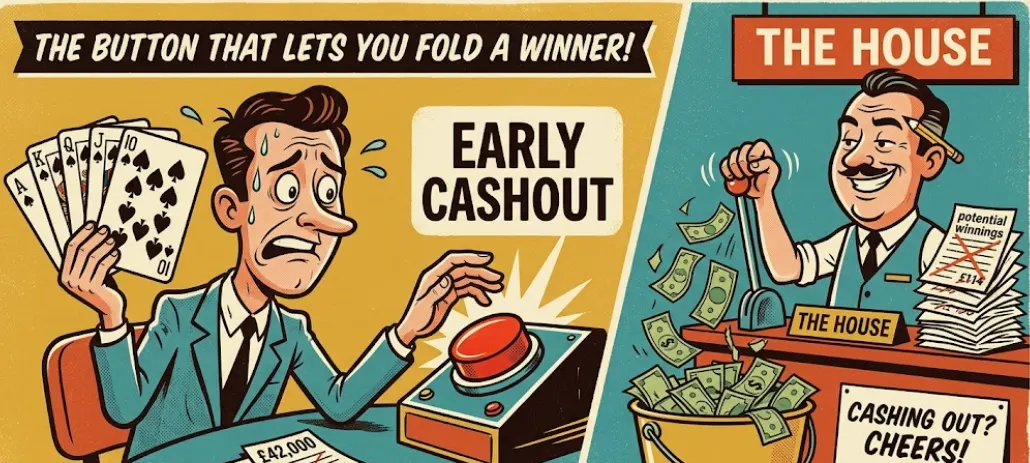
Early cashout is the feature sportsbooks introduced to give punters "control." In the betting industry, control is a lovely word that usually means the exact opposite of what it says. The cashout button lets you close a live bet before the final whistle to lock in a profit, salvage a dying stake, or make a panicked decision that will haunt you through your next three marriages.
Below is our list of top cashout-friendly online bookmakers that our editors have reviewed:





It is undoubtedly the most emotionally charged button on your sportsbook app. It sounds like a fantastic safety net, but the books built it with a massive margin in mind. Here is the reality of how cashout offers are calculated, when pressing the button actually makes sense, and why the sharpest bettors rarely go near it.
What Early Cashout Actually Is
A cashout offer is simply the sportsbook's real-time bid to buy back your open ticket. They calculate the current probability of your bet winning, multiply it by your potential payout, and then quietly shave off a hefty margin for the house.
The industry formula looks roughly like this:
Cashout Offer = (Potential Payout ÷ Live Odds) × (1 - Vig)
The vig (or juice) here is not a small number. When you cash out, you are often paying juice on top of juice. The original vig was already baked into the odds when you placed the bet pre-game.
Put it this way. If your $100 bet at even money now has an 85% chance to win, the true expected value of that ticket is $170. The book will cheerfully offer you $140 and call it a fair deal. That $30 gap is the insurance premium for your peace of mind. Books absolutely love it because they have built a booming business out of selling anxiety relief to the exact people who willingly placed the bet in the first place.
The Three Flavors of Cashout:
-
Full Cashout: You close the entire ticket for the offered amount. A clean exit.
-
Partial Cashout: You take a slice of profit off the top and let the rest ride. Highly useful on parlays when you want to secure your initial stake but keep some skin in the game.
-
Auto Cashout: You set a predetermined trigger. If the offer hits $X, the bet closes automatically. Think of it as a stop-loss, except you are capping your potential upside.
The Mathematics Nobody Wants to Hear
Over a large enough sample size, early cashout is a mathematically losing proposition. Sportsbooks are not offering this feature out of the goodness of their hearts. They offer it because the built-in margin on cashouts is significantly higher than the vig on a standard straight bet. It successfully turns ambiguous game outcomes into guaranteed, risk-free profit for the house.
A standard point spread bet carries a house hold of roughly 4.8%. Cashout offers can carry margins pushing 8% to 12% or higher. This is especially true on live markets, massive parlays, and futures where pricing is volatile and casual bettors are too stressed to shop around for true value. Live betting vig is already elevated due to the speed of the game and information asymmetry. When you stack a cashout margin on top of an already-juiced live line, you are essentially volunteering to pay the house twice just for the privilege of being nervous.
The Infamous Lincoln City Acca
If you need proof of what panic does to the brain, look no further than last month. In March 2026, a punter placed a £5 fifteen-fold accumulator at staggering odds of 8,590.48/1. Norwich won. Southampton won. Lincoln won. Bromley won. The ticket was beautifully alive. A full payout would have yielded around £42,000.
Somewhere along the line, the bettor got spooked and cashed out for £114.
The reactions on social media ranged from wildly sympathetic to utterly apoplectic. But the truth is simple. Human beings are not hardwired to perform expected value calculations when adrenaline hits the bloodstream. This physiological response is precisely why the cashout button exists.
When to Hold and When to Fold
Despite the brutal math, the cashout feature is not inherently evil. It is just a very expensive tool. Like any tool, it comes down to how and when you use it.
The Bookmaker's Quiet Trick: Cashout Suspension
There is a vital piece of the puzzle you must understand. Sportsbooks reserve the right to suspend the cashout feature the second a market gets volatile. A penalty kick is awarded, a goal goes to VAR review, or a team enters the red zone. The button turns grey.
There is almost always a 10 to 20-second delay on your cashout confirmation. During that window, the price can and will change if anything happens on the pitch. You are not locked in until the sportsbook explicitly confirms the transaction. This is not malice, it is basic risk management. However, it means you cannot rely on cashout as a guaranteed emergency exit. When the house is on fire, the exits lock.
The Smart Punter's Playbook
The punters who make consistent money over the long haul rarely touch the cashout button. They size their bets correctly, they build a thesis, and they live with the outcome. Cashout is fundamentally designed for bettors who are over-leveraged, under-researched, or emotionally invested past the point of rational thought.
If you size your bets so that a single loss does not hurt and a single win does not dictate your mood for the month, you will naturally ignore the cashout button.
Before you ever press it, ask yourself these three questions:
-
Has something tangible changed in this game that ruins my original pre-game analysis?
-
Would I gladly place this exact bet, right now, at the implied odds of the cashout offer?
-
If my bet ends up winning after I cash out, will I be annoyed for hours or fine in ten minutes?
If the answer to that last question is "annoyed for hours," you already know the math says hold. You are just looking for someone to give you permission to quit. Don't be the Lincoln City guy. Trust your read, protect your bankroll, and save the cashout button for absolute emergencies.