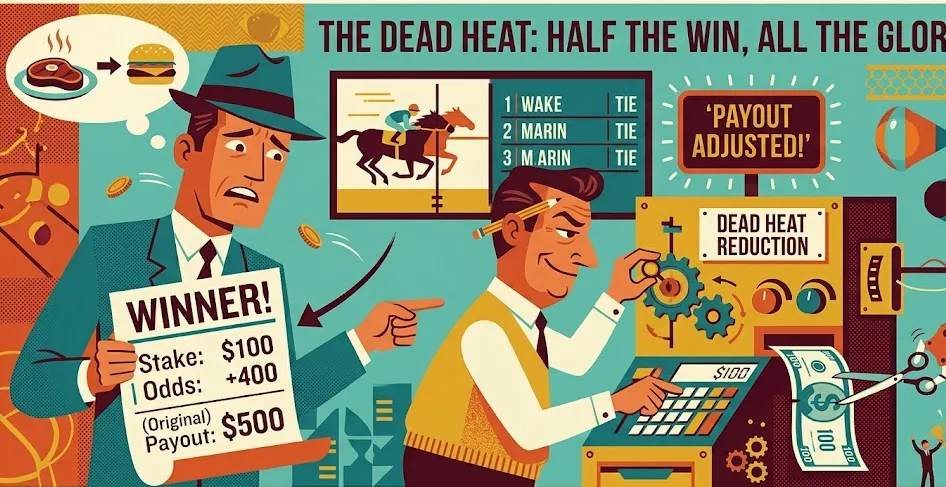
You nailed the pick. Your horse surged down the final stretch, or your dark-horse golfer sunk a miraculous 20-foot putt on the 18th hole. You pull out your phone, already calculating your winnings and deciding which moderately priced steakhouse you will visit tonight.
Then, the dreaded words appear on the broadcast: Dead Heat.
Suddenly, your payout is slashed. You feel robbed. You start checking your sportsbook app, wondering if there has been a glitch. There is no glitch. You have just become the latest victim of the dead heat rule, a perfectly legal and mathematically sound way for sportsbooks to ensure they do not go bankrupt when the universe decides a tie is the only fair outcome.
Understanding how dead heat deductions work separates the seasoned bettors from the casual weekend warriors. Bookmakers are not charities. When competitors share a winning position, sportsbooks are not going to magically multiply their payout pool. They divide it. Let us look at exactly how they chop up your money.
The Brutal Math Behind the Dead Heat
The concept is quite simple once you strip away the anger of a reduced payout. If two competitors tie for a position, your original stake is divided by two. If three tie, it is divided by three. Your odds remain exactly the same, but you are applying them to a fraction of your original bet.
Here is a real-world example to illustrate the damage. Imagine you bet $100 on a horse at +400 odds.
-
The Dream Scenario: Your horse wins outright. You get your $100 stake back plus $400 in profit. Total return is $500.
-
The Dead Heat Reality: Your horse ties for first place with one other runner. Your $100 stake is cut in half to $50. That $50 is then calculated at the original +400 odds. You win $200 in profit, plus your $50 adjusted stake back. Your total return is $250.
You still made a profit, but your mental steak dinner just downgraded to a fast-food combo meal.
High-Speed Cameras and the Pixel-Perfect Tie
You might think dead heats are a relic of the past. Surely modern technology can separate two horses or two greyhounds. Sportsbooks actually rely on incredibly advanced photo-finish technology to avoid dead heats whenever possible. Modern track cameras use slit-scan photography, capturing up to 10,000 individual frames per second. They measure margins down to the literal millimeter.
Yet, pixel-perfect ties still happen. A famous example occurred at the 2003 Breeders' Cup Turf. Two legendary horses, High Chaparral and Johar, hit the wire at the exact same fraction of a millisecond. Track officials scrutinized the ultra-high-definition image for nearly 15 minutes before officially throwing up their hands and declaring a dead heat. Millions of dollars in betting slips were instantly recalculated worldwide. When the technology says it is a tie, the sportsbooks start slicing stakes.
Golf Betting: The Ultimate Dead Heat Danger Zone
Horse racing dead heats are rare, but golf betting is where the dead heat rule truly massacres recreational bankrolls. This usually happens in the "Top 5" or "Top 10" placement markets.
Let us say you bet $50 on a golfer to finish in the Top 5. Sunday wraps up, and your guy finishes in a tie for 4th place. You celebrate. However, you look at the leaderboard and realize he is tied for 4th with four other players.
This means five golfers are occupying the 4th, 5th, 6th, 7th, and 8th positions on the leaderboard. Your bet was for a Top 5 finish, meaning only two of those available positions (4th and 5th) are actually paying out.
The sportsbook will take the number of winning positions available (2) and divide it by the number of tied players (5). That gives you 0.4. Your original $50 stake is multiplied by 0.4, leaving you with an active stake of $20. Your payout is calculated on that $20. In some cases with massive golf ties, your final payout can actually be less than your original wager. Winning a bet and still losing money is a special kind of pain that only sports betting can provide.
How to Protect Your Bankroll
You cannot control a photo finish, but you can control where and how you bet. Here are a few ways to navigate the dead heat minefield.
-
Shop for Promos: During major golf tournaments, heavily competitive sportsbooks often run "Ties Paid in Full" promotions. If you see this, take advantage immediately. It completely neutralizes the dead heat rule.
-
Read the House Rules: Every affiliate site will tell you this, but nobody actually does it. Spend five minutes reading how your specific bookmaker handles ties in different sports. Knowledge is literal power.
-
Adjust Your Expectations: If you are betting heavily on placement markets in golf or motorsports, factor potential dead heat deductions into your bankroll management.
The dead heat rule is not a scam. It is a necessary evil of the sports betting ecosystem. Keep your expectations realistic, understand the math, and remember that half a loaf of bread is always better than a completely torn-up betting slip.