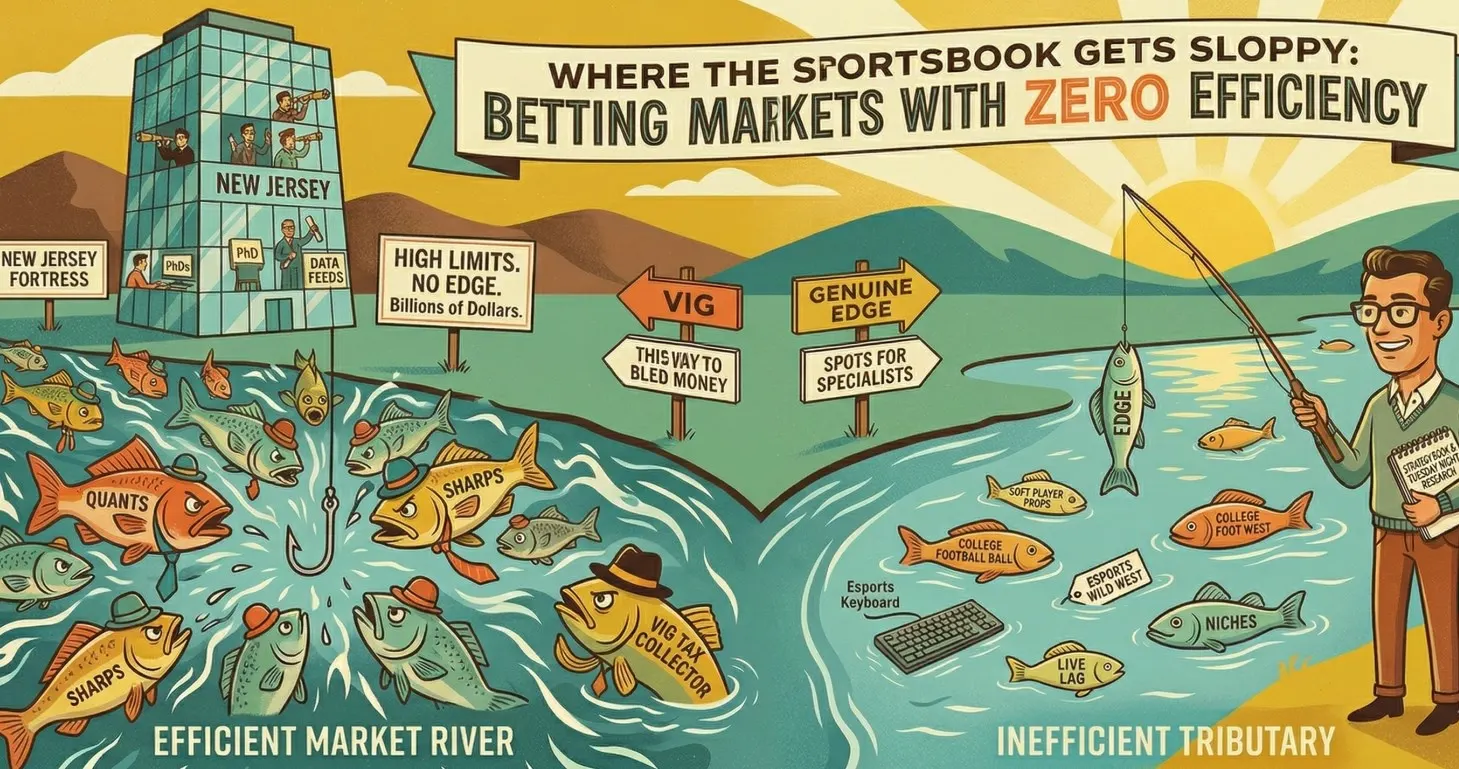
Somewhere in a glass tower in New Jersey, a team of quants is running regression models on Sunday Night Football spreads. They have PhDs. They have proprietary data feeds. They have algorithms that adjust for weather, injuries, and the emotional state of referees (probably). The NFL point spread market is their fortress, and it is very nearly impenetrable.
But here is the thing nobody at the fortress wants you to think about too hard: sportsbooks are not equally sharp everywhere. Not even close.
For every pristine NFL spread that has been hammered into shape by billions of dollars and thousands of sharp bettors, there are dozens of quieter markets where the oddsmaker is basically winging it. Markets where your Tuesday night research session and a decent spreadsheet might actually give you a genuine edge. Markets where the concept of "efficiency" is more of a polite suggestion than a mathematical reality.
This is a guide to those markets. Not the fantasy of beating the house at its own game on Monday Night Football. The far more interesting reality of finding the spots where the house has left the back door open.
What "Market Efficiency" Actually Means (And Why You Should Care)
Before we go hunting for soft lines, let's get the vocabulary straight, because the term "market efficiency" gets thrown around sports betting Twitter like a frisbee at a tailgate.
In the financial world, the Efficient Market Hypothesis (EMH) says that asset prices fully reflect all available information. Translated into betting terms: if a market is efficient, the odds perfectly represent the true probability of an outcome. There is no edge. No angle. No system that works long term. You are paying the vig and slowly bleeding money, no matter how clever you think you are.
The concept was first formalized by economist Eugene Fama back in 1970, and academics have been testing it in betting markets ever since. The verdict? It depends entirely on which market you are looking at.
A 2024 study published in Management Science analyzed 3,681 Major League Baseball games across four sportsbooks and found that betting lines actually tend to overreact to new information. The authors concluded there was sufficient evidence to reject weak form market efficiency in baseball, meaning the lines were not even properly incorporating past pricing data, let alone everything else.
Another study from East Carolina University examined moneyline odds across seven major North American sports over 16 seasons. Their finding: statistically significant inefficiencies in professional and collegiate football, college basketball, and MLB. The NBA and NHL, however, proved much harder to crack.
The takeaway for a regular bettor? Efficiency is not a blanket condition. It varies by sport, by market type, by time of day, and by how much attention the sportsbook's trading desk is actually paying.
The Spectrum of Efficiency: Where the Sharp Money Is and Isn't
Think of betting markets on a sliding scale. At one end, you have the most efficient markets in the world, including NFL sides and totals. At the other end, you have your cousin's office Super Bowl prop sheet about the length of the national anthem.
The general rule: the more money and attention a market attracts, the more efficient it becomes. Sharp bettors (or "wiseguys," if you prefer the vintage term) swarm the highest-volume markets, correcting mispriced lines through their own action. Their money is the invisible hand that pushes odds toward true probability.
But sharp money is a finite resource. Professional syndicates focus where the limits are highest, because that is where they can deploy serious capital. A sharp bettor who finds an edge on an NBA spread can put down $10,000 to $50,000 at major books. That same bettor finding an edge on a second-tier soccer prop? They might be capped at $250 before the book shuts them down. So they don't bother. And the line stays soft.
This is the fundamental reason certain markets remain inefficient: the sportsbook's own defense mechanism, low betting limits, paradoxically protects bad lines from being corrected.
Here is a rough efficiency ranking, from tightest to loosest:
Fortress-level efficiency: NFL sides, NFL totals, NBA sides, NHL moneylines
Strong but imperfect: MLB moneylines, Premier League match odds, NBA totals
Meaningfully inefficient: College football spreads, college basketball moneylines, player props (all sports), MMA, tennis live betting
Wide open territory: Esports, lower-division soccer, niche props, cross-sport parlays, early-season lines, weather-affected totals
Let's walk through the specific weak spots.
College Football: Where Tradition Beats the Spread
If academic research has crowned any single market as reliably inefficient, it is college football.
A landmark study from Ohio State University examined over 11,000 college football games from 1985 to 2003 and reached a conclusion that should make every casual bettor sit up: favorites are systematically overpriced. The researchers estimated that betting $1,000 on underdogs in prominent games would have returned $1,116.99 in expectation, before the vig. That is a meaningful edge in a world where most bettors consider breaking even a victory.
Why does this happen? The answer involves psychology, not mathematics. College football has something the NFL does not: brand power that distorts perception. When Alabama rolls into town, the betting public sees the name on the jersey and reaches for their wallet. Sportsbooks know this. They deliberately shade lines toward popular teams because they know the money is coming anyway.
Research from multiple institutions has confirmed that previously top-ranked teams are systematically overvalued in early-season betting markets. One study found that bets against the previous season's top 10 teams won significantly more than the 52.4% break-even rate needed for profitability against the standard vig. The effect was especially strong when those ranked teams played smaller opponents.
Home underdogs in college football have been another persistent source of inefficiency. Academic data consistently shows they cover at a rate well above chance. In certain conferences, like the Big 12, home underdogs have been covering at roughly 58% against top-20 road favorites over recent seasons. That is not noise. That is a structural flaw.
The mechanism is straightforward: betting houses inflate lines to counteract what researchers call "hot hand" beliefs. Bettors love momentum. They see a team on a winning streak and assume it will continue. Sportsbooks lean into this bias, pushing the line further than the true probability warrants. The result is a predictable overcorrection that leaves value on the other side.
Player Props: The Sportsbook's Soft Underbelly
If college football spreads are the most academically studied inefficiency, player props are the most practically exploitable one for recreational bettors right now.
The numbers tell the story. A major sportsbook might set lines for 150 to 200 different player prop markets on a single NFL Sunday. That is thousands of individual prices that need to be accurate. The trading desk that spends hours perfecting the Chiefs-Ravens spread simply does not have the bandwidth to apply the same rigor to the rushing yards over/under for a backup running back in the Jaguars game.
Structural factors make props inherently softer than game lines. Sportsbooks have decades of refined models for predicting game outcomes. Props are newer, with less historical data to inform the lines. The modeling is harder, the data is thinner, and the margins for error are wider.
Then there is the demand side. Recreational bettors love props because they are fun. You can root for your favorite player to have a big game. But "fun" bettors tend to create predictable distortions: they overbet overs (because cheering for more of something is more exciting than less of it), they overbet star players (because name recognition feels like analysis), and they chase recent performance (because a 300-yard game last week surely means another one this week, right?).
Sportsbooks know all of this. They shade lines accordingly, pushing overs higher than they should be to capitalize on public tendencies. In theory, this creates value on unders. In practice, you need to do the actual work of projecting player performance to know which unders are genuinely mispriced.
The real gold in props comes from information asymmetry. When a starting running back is ruled out 90 minutes before kickoff, the backup's rushing prop will adjust, but often not aggressively enough. During the 2023/24 NBA season, when Luka Doncic was ruled out for a Mavericks game, the line overreacted by swinging too far in favor of Minnesota, creating value on Dallas for bettors who understood the team's depth. These are windows that close fast, but they open regularly enough to matter.
Obscure props offer even more opportunity. A sportsbook will devote serious resources to pricing Patrick Mahomes' passing yards accurately. Mahomes' backup's completion percentage prop in a preseason game? That line might as well be a dartboard estimate.
Esports: The Wild West With a Keyboard
If you want to see what a truly immature betting market looks like, esports is it. One prominent esports model operator put it bluntly: esports betting today is where NBA betting was 20 years ago, with fewer sharp players, less volume, and softer lines.
The inefficiency here is structural and severe. Most traditional sportsbooks treat esports as an afterthought. They have small teams, if any, dedicated to pricing League of Legends or Counter-Strike matches. The models are less sophisticated. The data pipelines are newer. And crucially, the people setting the lines often understand the games less deeply than the bettors wagering on them.
This creates an unusual dynamic. In NFL betting, the average recreational bettor knows less about football than the oddsmaker. In esports, the reverse is frequently true. A dedicated League of Legends player who follows the pro scene might genuinely understand team compositions, patch impacts, and meta shifts better than the trader pricing the match. That knowledge gap is the very definition of exploitable inefficiency.
Research has confirmed unusual patterns in esports markets. A study on Counter-Strike betting found a reverse favorite-longshot bias, meaning favorites were actually overbet (the opposite of what happens in most traditional sports). This suggests the market's pricing models have not matured enough to properly calibrate odds across the probability spectrum.
Live esports betting is even softer. The speed of in-game events, combined with the relative novelty of real-time esports pricing algorithms, creates frequent moments where the odds lag behind reality. A team losing the first map in a best-of-three series might see their live odds crater, even when the map pool heavily favors them on Maps 2 and 3. Traditional sharp bettors rarely touch these markets because the limits are too low. That means the self-correcting mechanism that tightens NFL lines barely functions here.
The Favorite-Longshot Bias: A Universal Flaw
One inefficiency appears across virtually every betting market on Earth, and it has been documented since 1949: the favorite-longshot bias.
In plain terms: longshots are consistently overpriced. Bettors systematically overestimate the probability of unlikely outcomes and are willing to accept terrible odds for the thrill of a big payout. Sportsbooks, being rational businesses, lean into this tendency by taking extra margin on longshot prices.
The research from the National Bureau of Economic Research paints a vivid picture. Across millions of horse race starts in the United States from 1992 to 2001, a bettor on favorites might lose 5% of their stake over time. A bettor on longshots? They would lose around 40%. The bias has been documented in soccer, tennis, college sports, and most other markets with a wide range of possible odds.
What makes this relevant for recreational bettors is not the raw phenomenon (you already knew longshots rarely hit) but the implication: not all bets carry the same hidden cost. The sportsbook's margin is not distributed equally across the market. Short prices carry less embedded margin than long ones. This means that even without any edge on picking winners, you are structurally less disadvantaged betting on moderate favorites than on extreme longshots.
The exception proves the rule: research on MMA betting markets found no evidence of a favorite-longshot bias. Combat sports have unique characteristics (single-elimination, high variance, frequent upsets) that may prevent the usual pattern from taking hold. Bettors considering heavy favorites in MMA should factor in that the pricing in that sport does not carry the same built-in underdog tax.
Live Betting: Speed Kills (Their Margins)
In-play betting has exploded in recent years, now accounting for the largest revenue share of the global sports betting market. And it has created an entirely new category of inefficiency: the lag.
Here is the problem sportsbooks face with live betting. They need to update odds in real time as events unfold. For major sports, they use sophisticated algorithms that process data feeds and adjust prices multiple times per second. But algorithms have blind spots. They react well to scoring events and clock situations. They react less well to context.
A quarterback limping after a sack but staying in the game. A basketball team shifting to a zone defense in the second half. A soccer manager making a tactical substitution that changes the team's shape. These are situations where a knowledgeable viewer can recognize a shift in probability before the algorithm catches up.
Tennis live betting is particularly notorious for arbitrage opportunities because the binary nature of the sport (one player winning each point) combined with the relatively slow human reaction time of traders creates frequent small windows where odds across different books are misaligned.
The practical challenge for recreational bettors is speed. Professional live bettors use automated systems and direct data feeds to exploit these windows in milliseconds. If you are tapping your phone while watching from the couch, you are not competing on speed. But you can compete on context, recognizing momentum shifts, fatigue, and tactical changes that pure data models miss.
Lower-Division Soccer and Niche Leagues: The Blind Spots
The global soccer betting market is enormous, and the top leagues are priced with surgical precision. Premier League match odds major EU-facing sportsbooks are among the most efficient prices in all of sports betting.
But drop down two or three divisions and the picture changes dramatically. A study of 51 online bookmakers pricing English football matches found that while the overall market was not biased, individual bookmakers failed to fully incorporate information from their competitors' odds. Each book was, in a sense, operating in its own bubble.
This effect magnifies in lower divisions and less popular leagues. When a sportsbook is pricing a match in the Swedish second division or the Korean K League 2, the trading team is often relying on limited data and algorithms that have been calibrated primarily for top-tier competitions. Local factors, including recent managerial changes, player morale, pitch conditions, travel fatigue, all carry more weight in these environments and are harder for automated models to capture.
The same principle applies to any sport where mainstream attention drops off: minor league baseball, lower-tier tennis tournaments, women's sports leagues where betting volume is growing but modeling sophistication has not kept pace. If you know a sport or a league well enough to spot things the pricing model misses, that is where the edge lives.
MLB Weekend Day Games: A Quirk of Timing
Here is a specific and delightfully weird inefficiency: Major League Baseball lines at the start of weekend day games are significantly worse (from the sportsbook's perspective) than lines posted 90 minutes earlier.
This counterintuitive finding, from the Management Science study mentioned earlier, defies the basic assumption that more information should produce better forecasts as game time approaches. The likely explanation involves staffing. Sportsbook trading desks have their A-team working prime-time evening games. Weekend afternoon baseball? That might be the B-team, or even automated systems with less human oversight. Late lineup changes, pitching decisions, and weather developments that come in during the final 90 minutes before a day game may not get properly incorporated.
For the bettor who enjoys a Saturday afternoon at the ballpark (or on the couch), this represents a narrow but real window. Lines posted for early games on weekend mornings may actually be more accurate than the lines available right before first pitch, meaning late line movement on day games deserves skepticism rather than automatic trust.
How to Actually Use This Information
Knowing that inefficiencies exist is only useful if you can do something with the knowledge. Here is a practical framework for the recreational bettor who wants to fish in softer waters:
Specialize, do not generalize. The single most effective thing you can do is know one sport, one league, or one market type better than the sportsbook's model does. You will never out-model FanDuel's NFL department. You might out-think their Korean baseball pricing. Pick a lane and own it.
Line shop relentlessly. Odds on player props can vary significantly between books because different sportsbooks use different models. Having accounts at three to four books and checking prices before every bet is not optional. It is the foundational habit that separates losing recreational bettors from break-even ones. Even small differences compound: betting at -105 versus -110 saves roughly $500 over 100 bets at $100 each.
Respect the over bias. In prop markets, the public loves overs. Sportsbooks shade accordingly. This does not mean blindly betting every under, but it means your default assumption should be that overs are slightly overpriced relative to unders. Let the math confirm or deny before you act.
Watch for news-driven windows. The fastest path to finding soft lines is being first to react to breaking information. Injury reports, lineup changes, weather updates, coaching decisions: these are all inputs that take time to be fully reflected in the odds. If you are watching injury reports drop at 4:30 PM and placing bets before the 5:00 PM line adjustment, you are operating in the inefficiency window.
Avoid extreme longshots. The favorite-longshot bias is real and it is expensive. A +2000 underdog might feel exciting, but the implied probability baked into that line carries vastly more sportsbook margin than a +150 underdog. Unless you have a specific, data-driven reason to believe that longshot is mispriced, the math says walk away.
Track your results honestly. The biggest enemy of the recreational bettor is not the sportsbook's margin. It is selective memory. You remember the parlay that hit. You forget the eight that didn't. Track every bet, calculate your actual ROI, and let the numbers tell you whether your "edge" is real or imagined. A Google Sheet and 30 seconds of honesty after each bet will save you more money than any tout service.
What Did We Learn
The sports betting market is not a monolith. It is an ecosystem of thousands of individual markets, each with its own level of pricing accuracy, its own amount of sharp money pressure, and its own unique blind spots. The NFL point spread is a nearly perfect forecasting instrument. A backup tight end's receiving yards prop in a college bowl game is an educated guess with a vig attached.
The sportsbook's edge is real, and it is structural. Nobody is suggesting you can just waltz into inefficient markets and start printing money. The vig exists everywhere, the books adjust, and anyone selling you a guaranteed system is selling you a fantasy.
But the game is not equally stacked against you in every corner. If you are willing to specialize, to do the homework, to operate in the markets that the quants in the glass tower consider beneath their attention, you can play a meaningfully different game than the one the sportsbook expects you to play.
And in a world where the house always has an edge, playing a different game is the closest thing to an advantage you will ever find.