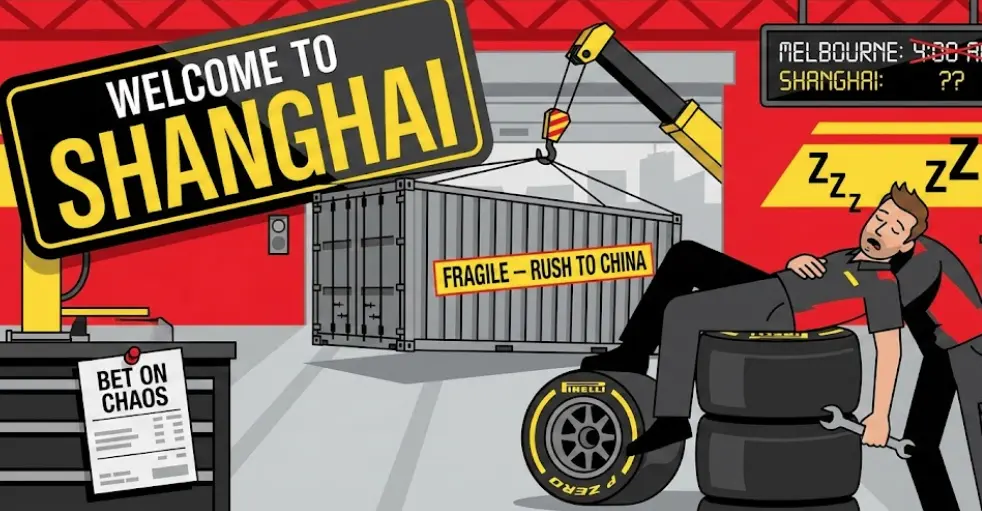
Everyone loves the Australian Grand Prix. It is the first day of school. The cars are shiny, the drivers are optimistic, and the fans in Melbourne are buzzing. But for the teams? It is a nightmare that is just getting started.
As soon as the champagne dries in Albert Park, the entire circus has to pack up and sprint to China in less than a week. We are talking about a brutal logistical back-to-back that separates the elite operations from the chaotic ones. And that is exactly where you can find your edge.
Forget lap times and wind tunnel data for a second. In the early season, you are betting on logistics, sleep deprivation, and mechanics who are running on caffeine and hope. Here is how to profit from the "Shanghai Surprise."
The "Zombie Mechanic" Factor
The flight from Melbourne to Shanghai is about 10 hours. The freight takes longer. The teams often land in China with their internal clocks completely scrambled, and they have to rebuild the cars from scratch in 48 hours.
This is where human error creeps in. When a mechanic is fighting a migraine and jet lag, cross-threaded wheel nuts happen. Missed sensor calibrations happen.
The Betting Angle: Look at the "Over/Under on Pit Stop Times" or "Number of Classified Finishers." The books often set these lines based on optimal performance. But China in March is rarely optimal. If the books offer a line on a "Pit Lane Speeding Penalty," take it. Tired drivers make small mistakes that cost big money.
Fade the Midfield in Head-to-Heads
Red Bull, Ferrari, and Mercedes have private logistical armies. They have the budget to fly in fresh staff or pay for the best freight priority. The smaller teams? They are flying commercial and waiting for their shipping containers like the rest of us wait for luggage.
When a team like Haas or Williams has a crash in Australia, the repair job for China is rushed. They might be using repaired parts instead of new ones because the spares are still in a cargo plane somewhere over the Philippines.
The Betting Angle: Hammer the Head-to-Head (H2H) markets. If a midfield driver had a rough weekend in Australia, bet against them in China. Fade them against a driver from a team with a bigger budget. You are not betting on driver skill here. You are betting on the fact that Team A has a fresh gearbox and Team B is using duct tape.
The "First Lap" Chaos Theory
The Shanghai International Circuit has one of the trickiest starts on the calendar. Turns 1 and 2 tighten into a never-ending snail shell that squeezes 20 cars into a space meant for two. Combine that with cold tires (it is often chilly in Shanghai in March) and drivers desperate to make up for a bad Australian GP, and you have a recipe for carbon fiber confetti.
The Betting Angle: Look for "Safety Car in Lap 1: YES" or "Total Retirements: Over 2.5." The books often undervalue the chaos potential of the first lap in China, especially when the grid is mixed up from early-season reliability penalties.
The "Wait for Suzuka" Rule
If you want to bet on who actually has the fastest car, keep your wallet closed until Japan. Australia is a street track. China is front-limited and often cold. Neither of them tells you the truth about aerodynamic performance.
Suzuka (Round 3) is the lie detector. It is a pure high-downforce track. If a car is fast in the high-speed snake sector at Suzuka, it is fast everywhere.
The Betting Angle: Use Australia and China to build your bankroll on chaos bets (Safety Cars, DNFs, H2Hs). Save your "Championship Winner" or "Race Winner" bets for Japan. By then, the true pecking order will be clear, and you won't be guessing based on a fluke result in Melbourne.
The early season is not about speed. It is about survival. The teams are rusty, the cars are fragile, and the travel schedule is brutal. Stop trying to predict who will sit on pole position and start looking at who is most likely to crack under the pressure.
Your Move: Check the "Both Cars to Points Finish" market for the top teams. In the chaos of the Shanghai turnaround, even the giants can stumble. If you can get decent odds on "No" for a top team, it might just be the value play of the weekend.