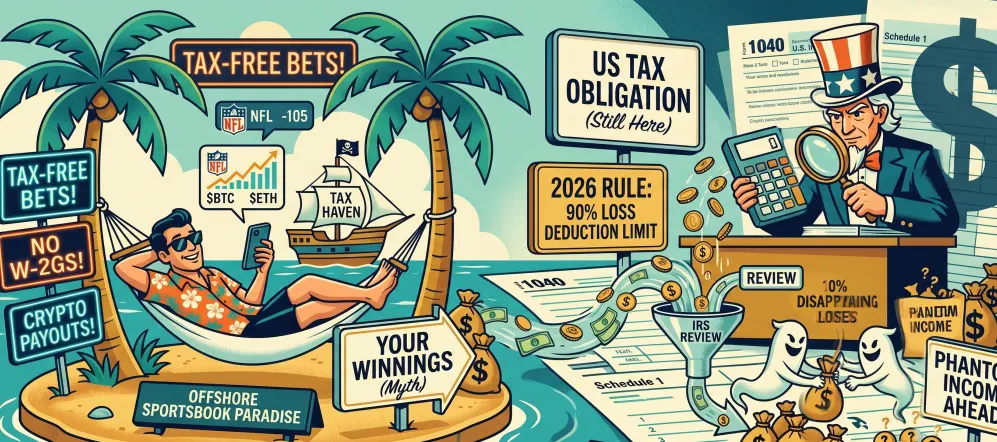
Type "tax-free offshore bookmakers" into Google on any given Sunday and you will find thousands of pages promising something between a legal grey area and a pirate cove. Crypto payouts in an hour. No 1099 forms. No ID verification until withdrawal. A bonus the size of a used Hyundai. Somewhere in the fine print, usually in a font smaller than the terms they really want you to read, there is a disclosure that says "US players are responsible for their own tax obligations." That single line is doing more work than the NFL replacement refs did in 2012...
This is our list of trusted Tax-Free Offshore Bookmakers, all reviewed and vetted by our editorial team:







So let us talk about this properly, because the phrase "tax-free" in this context is a little like "sugar-free" on a cereal box that contains maltodextrin and regret. The offshore sportsbook is tax-free in a very specific sense. You as the player are not.
What "tax-free" actually means when you see it on an offshore betting site
When an offshore bookmaker advertises itself as tax-free, they usually mean one or more of three things, and they rarely spell out which one.
The first meaning is the one most American bettors land on subconsciously: the book does not automatically send a W-2G or 1099 to the IRS when you win. That part is true for the overwhelming majority of offshore bookmakers licensed in Curacao, Anjouan, Panama, or Costa Rica. They have no US tax reporting relationship because they have no US regulatory relationship. They are not your payroll department. Nobody is sliding a form into an envelope for you in February.
The second meaning is that the sportsbook itself pays no US corporate tax on the handle it takes from American players. This is correct. An offshore operator pays tax in its licensing jurisdiction, and those rates are frequently closer to a cappuccino than a mortgage payment. Curacao-licensed books pay roughly 2 percent on net profit under the old NOOGH framework, updated under the new LOK regime. That is one of the reasons the odds at an offshore book can genuinely be sharper than a New York regulated sportsbook, which has to cough up 51 percent of gross gaming revenue in state tax before anyone gets paid. The math on a line like NBA spreads at minus 105 versus minus 110 is not magic. It is just tax arbitrage wearing a hoodie.
The third meaning is a marketing fiction. It is the implication, never stated directly because the lawyers would not allow it, that because the book does not report to the IRS, the player somehow does not owe tax on the winnings. That is flatly, verifiably, and irritatingly not how federal tax law works.
Gambling winnings are taxable under Internal Revenue Code section 61, which defines gross income as "all income from whatever source derived." Note the phrase "whatever source." Uncle Sam is not picky about country codes. If you live in the United States and you profit from betting on the Chiefs, the IRS wants its cut whether that bet was placed on DraftKings in New Jersey or BetOnline on a server in Panama City. Offshore sportsbooks do not issue W-2Gs, but the IRS obligation sits with you, not with them, and it always has. What offshore operators remove is paperwork. What they do not remove is liability.
The 2026 changes that make this conversation actually interesting
Here is where the topic suddenly got timely, because 2026 has been a genuinely weird year for American gambling tax policy.
Two things shifted at the federal level, and both came out of the One Big Beautiful Bill Act signed on July 4, 2025. The first is good news for casual bettors. The old W-2G reporting threshold for sports wagers, which had a $600 trigger combined with the 300-to-1 payout ratio, moved to $2,000. The threshold will adjust annually for inflation going forward, which is the first time in half a century that gambling reporting thresholds have been indexed to the real world. If you have ever had a Texas regulated, wait, scratch that, if you have ever had a DraftKings parlay hit for $850 and felt personally insulted by the tax form it generated, that particular insult is gone.
The second change is bad news for almost everyone. Starting January 1, 2026, gamblers can only deduct 90 percent of their losses against their winnings, under the revised Section 165(d). Ten percent of your losses simply vanishes into tax-code vapor. That sounds esoteric until you run the numbers. Win $100,000 over the year, lose $100,000 over the same year, and under 2025 rules you break even and pay zero federal tax on gambling income. Under 2026 rules you report $100,000 in winnings, can only deduct $90,000 in losses, and owe federal income tax on $10,000 of money you never actually had. That is what the industry is calling phantom income, and it is not a metaphor.
The Fair Bet Act and the Wager Act have both been introduced to repeal the 90 percent limit. They have bipartisan support. They have also not passed. Until they do, break-even gamblers owe tax.
This is the environment in which the search traffic for "tax-free offshore sportsbooks" has genuinely exploded. The phrase is misleading, but the motivation is not. Bettors are asking a real question: given that the tax code now punishes me for breaking even, what are my options?
What offshore actually changes and what it does not
Let us separate signal from noise.
Offshore does change the paperwork burden. No W-2G means no automatic trigger at the $2,000 threshold. Nobody is carbon-copying the IRS when you win a Thursday night parlay. That is a real difference, and pretending otherwise is silly.
Offshore does change your withholding situation. Regulated US bookies can withhold 24 percent of winnings above certain thresholds, depending on the wager type and the 300-to-1 multiplier. Offshore books withhold nothing. The full amount of a $10,000 crypto withdrawal lands in your wallet, and the question of what you owe on it becomes your problem in April.
Offshore does change your access to odds that are not compressed by a 51 percent tax rate on the operator. This is the one that serious bettors care about. A sharp line at minus 105 versus a regulated line at minus 115 compounds over a year. If you bet $200 per game and you place 400 bets a season, that juice differential is real money.
What offshore does not change: your legal obligation to report gambling income on your 1040. The IRS sees offshore and domestic winnings as identical in character. They are both "gambling winnings, not from wagering pools" on Schedule 1, Line 8. There is no different line for offshore. There is no footnote. Your CPA does not file a separate form for winnings obtained via Curacao.
The practical reality, which every tax attorney who handles gambling clients will confirm if you buy them a drink, is that the IRS has a far harder time noticing undeclared offshore winnings than undeclared domestic ones. That is not a recommendation to underreport. That is just a fact, the way saying "the odds of getting caught speeding at 3 AM are lower than at 3 PM" is a fact. The penalties for underreporting, if caught, remain exactly the same. Interest, penalties, and potentially fraud charges do not soften because the sportsbook was based in Willemstad.
The crypto layer, which complicates everything
Most offshore bookmakers are now primarily crypto-funded. This is not aesthetic preference. US banks routinely block outbound wires to offshore gambling merchants under internal compliance policies, which is why Bitcoin, Ethereum, Litecoin, and the usual stablecoin suspects became the default rails. BetOnline processes crypto withdrawals in under 24 hours, BetNow claims one-hour payouts, and lightning network options are starting to show up at platforms like Betplay.
Here is the part most "tax-free offshore" articles forget. Every crypto transaction is its own taxable event for US players. When you deposit $500 of Bitcoin you bought at a different price six months ago, you might have a capital gain or loss on the deposit itself. When you withdraw $1,200 of Bitcoin and the price moves between receipt and conversion to dollars, that movement is also taxable. The sportsbook did not simplify your taxes by paying in crypto. It added a second layer of them.
TokenTax, CoinLedger, and similar services exist because this situation genuinely requires software. For anyone running offshore action in crypto at any meaningful volume, handling the tax on paper is roughly as practical as doing your own knee surgery. Possible. Unwise.
The real question: what do sharp recreational bettors actually do
Here is the unvarnished version, because the recreational bettor reading this deserves it.
Serious recreational players, the kind who bet consistently and track their action, treat the offshore tax question as a bookkeeping problem, not a loophole. They use offshore books for the better odds, the bigger limits, the faster crypto payouts, and the lack of account-limiting when they win, which is a far bigger issue at domestic regulated books than the industry likes to admit. DraftKings will quietly throttle a consistently winning account inside a month. BetOnline will take your action for a decade.
They keep session logs. Not because the IRS will audit them tomorrow, but because if the IRS ever does come asking, the absence of records is what turns a bookkeeping discussion into a fraud investigation. Publication 529 specifies what to keep. Date, location, type of wager, amount, outcome. Casino win-loss statements alone do not cut it under the new session-based reporting approach that tax professionals are increasingly recommending for 2026.
They understand the 90 percent rule and they plan for it. A break-even player with $50,000 of wins and $50,000 of losses in 2026 will owe federal tax on $5,000 of phantom income. That is a real number. It deserves a real line in a real financial plan, not a shrug.
And they tell the truth on their returns. The reason is boring and not particularly noble. It is that the downside of getting caught is catastrophic and the upside of not reporting is merely avoiding a check that was always going to be written. The math has never favored dishonesty for a rational actor. It favors it even less in 2026 because the IRS now has budget specifically earmarked for gambling income enforcement, funded in part by the OBBBA itself.
The genuinely tax-advantaged play that nobody advertises
There is a thing that is genuinely called a "tax-free offshore sportsbook," and it exists, and it is not for American residents.
If you are a non-US citizen and non-US resident living in a jurisdiction that does not tax gambling winnings, places like the United Kingdom, Ireland, Germany, or Canada for recreational players, an offshore sportsbook licensed outside your home country may indeed present zero tax liability. The UK does not tax individual gambling winnings at all. Neither does Canada for non-professional players. The bet is tax-free at origin and tax-free at payout.
For Americans, this particular version of tax-free is a passport away, not a login away. That distinction is what separates the offshore industry's most honest marketing from its least honest marketing.
The short version, for the reader who scrolled
Offshore sportsbooks do not send your data to the IRS. They also do not make you tax-free. You are still a US taxpayer betting from a US address with a US Social Security Number attached to it, and the code that governs gambling income is indifferent to the server location of the book that paid you.
The reason to use an offshore sportsbook in 2026 is not the tax fantasy. It is the sharper lines, the bigger limits, the faster crypto cashouts, the tolerance for winning accounts, and the welcome bonuses that would get a regulated book fined into the parking lot. Those are real, measurable, and worth an article on their own.
The reason not to use one is also real. You have no US regulatory recourse if something goes wrong. You have to manage your own tax paperwork. And you have to understand that the word "tax-free" in the marketing is doing a very specific, very limited job.
Bet sharply. Keep records. Do not confuse paperwork for policy. And if anyone on a forum tells you that winnings from an offshore book are untaxed because the server is in Panama, assume they have not yet met the person from the IRS who disagrees.