There are many ways for a sports bet to go wrong. A missed penalty, a late red card, a garbage-time basket that ruins a total. Most bettors accept those moments as part of the deal. But few situations cause as much confusion as an abandoned match.
You are watching the game and your bet looks good. The scoreline is moving exactly how you hoped. Then suddenly the referee stops play. Maybe a storm rolls in, maybe the lights fail, maybe something more serious happens on the field. After a long delay the decision arrives. The match will not continue.
The betting slip in your account is suddenly more interesting than the game itself. What happens now?
The short answer is that most bets are simply cancelled. But as with most things in sports betting, the real answer sits somewhere inside the rulebook.
Why Most Abandoned Match Bets Are Voided
In most sportsbooks, a match needs to be completed in order for standard bets to be settled. If the game is abandoned before its official conclusion, bookmakers typically declare all unresolved bets void.
A void bet simply means your stake is returned. You do not win anything, but you also do not lose. The bet disappears from the slip and the money returns to your balance.
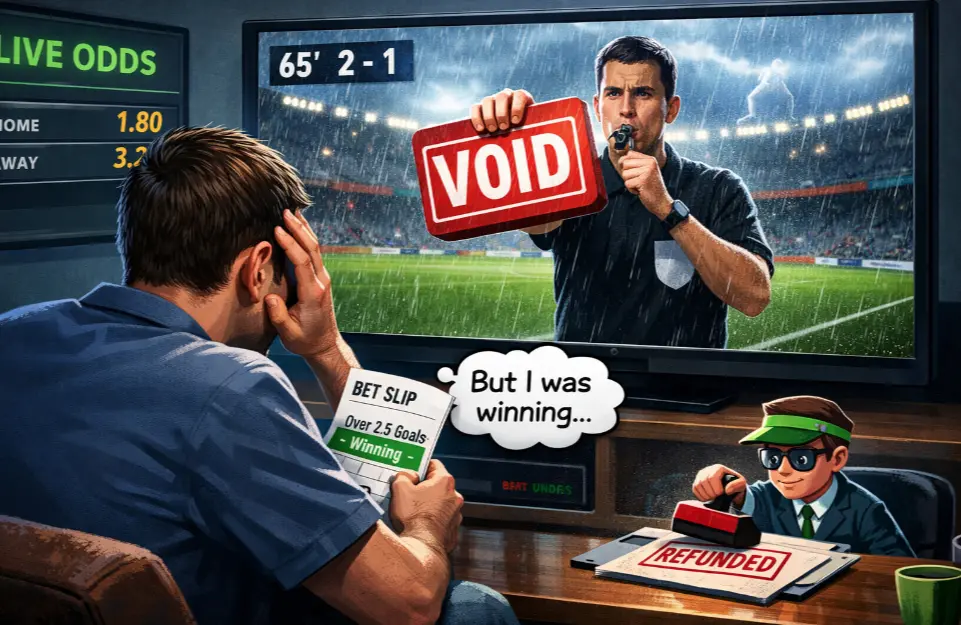
For bettors, this outcome can feel strangely unsatisfying. Imagine backing over 2.5 goals in a football match that reaches 2–1 by the 65th minute. Technically the bet has already landed. But if the match is abandoned shortly after, the sportsbook usually treats the entire market as unresolved. Without a completed match, the bet is cancelled and the stake refunded.
From the bettor’s perspective it can feel unfair. From the bookmaker’s perspective it is simply a rule applied consistently across all matches.
When Bets Still Stand After an Abandoned Match
Not every bet depends on the full match being played. Some markets are settled the moment their outcome becomes clear, which means they can still be paid even if the game later falls apart.
A first goal scorer bet is the classic example. Once the opening goal has been scored, the market has a clear result. If the match is abandoned later, that fact does not change who scored first.
The same logic can apply to certain first-half markets, provided the first half was completed before the match was abandoned. If you backed a team to win the first half and that result was already decided, the bet can still stand even though the full match never finished.
This is why two bets from the same game can end up with different outcomes. One might be settled and paid out while another quietly returns as a void bet.
What Happens to Accumulators
Accumulator bets add another small twist to abandoned matches. When one leg of a parlay is voided, the bet usually continues but with adjusted odds.
If a five-leg accumulator loses one match to abandonment, that leg simply disappears from the bet. The ticket becomes a four-leg accumulator instead, and the potential payout drops accordingly.
For bettors this is rarely dramatic, but it can be mildly annoying if the abandoned game was the shortest odds in the entire slip. What once looked like a large payout can shrink surprisingly fast when the odds are recalculated.
Still, the important point is that the bet survives. A void leg does not kill the entire accumulator.
Why Bookmaker Rules Can Differ
While most sportsbooks follow broadly similar principles, the details can vary more than many bettors expect. Some bookmakers require a match to be completed on the same day in order for bets to stand. Others allow the game to resume within twenty-four hours.
In some competitions an abandoned match may continue the next day from the minute it stopped. Certain sportsbooks will settle bets according to the final official result of that resumed match. Others prefer the simpler approach of voiding all bets the moment the match is abandoned.
These differences rarely become visible until something unusual actually happens. That is why experienced bettors eventually learn that the dullest section of any sportsbook website, the betting rules page, can sometimes be the most important.
Why Matches Get Abandoned in the First Place
Despite the drama they create for bettors, abandoned matches are relatively rare events in major professional leagues. Still, they do happen.
Severe weather is the most common reason, especially in outdoor sports where heavy rain or lightning can make conditions unsafe. Stadium power failures occasionally bring games to a halt, and crowd trouble has also forced referees to abandon matches in the past. Medical emergencies involving players or officials can lead to the same decision.
In smaller leagues the chances can be slightly higher due to less reliable stadium infrastructure or difficult weather conditions. In indoor leagues like the NBA, where arenas are controlled environments, abandonments are far less common.
The Quiet Lesson for Bettors
The abandoned match rule is not the most exciting topic in sports betting, but it reveals something important about how bookmakers operate. Betting markets are governed less by common sense and more by clearly written rules that apply across thousands of events.
Most of the time this system works smoothly. When a match ends normally, bets are settled without anyone thinking twice. But when a game stops halfway through, the rulebook suddenly becomes the most important player in the stadium.
For bettors the best approach is simply awareness. Knowing that most unfinished matches lead to void bets helps avoid confusion when the rare abandonment does happen.
And when the referee eventually walks the players off the field while rain pours down or floodlights flicker out, the real drama for many bettors is not the match itself. It is the quiet moment a few seconds later when they check their account and discover whether the betting slip has survived, been settled, or politely erased by the fine print.