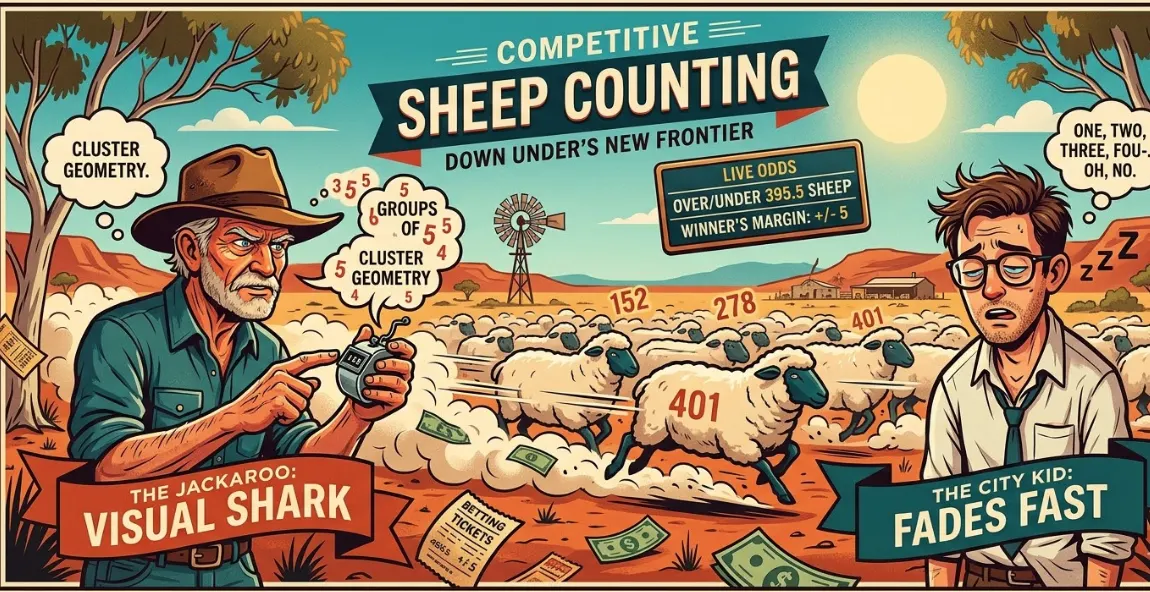
You think you have a sharp edge because you fade the public on Monday Night Football or throw a twenty on a Tuesday night table tennis match in Eastern Europe. You sit there watching grainy footage, convincing yourself you have a read on the backhand of a guy named Vlad. That is cute. But if you want to test your mettle on the true frontiers of niche competition, you need to look Down Under. Australia, a land where everything wants to kill you, has successfully weaponized insomnia. Welcome to the high stakes world of competitive sheep counting.
Yes, sheep counting is an official sport in Australia. And before you ask, no, they do not provide pillows.
Let us get the rules out of the way. You might picture a quiet meadow with fluffy white clouds, but the reality is essentially a woolly stampede. Around 400 sheep are released to make a mad dash past a lineup of ten competitors. The objective is brutally simple. Count the sheep. The participants do not know the exact number in advance. They are not allowed to move from their spots, and they certainly cannot block the vision of the guy standing next to them. When the dust settles, the referee takes the estimates. The closest number to the actual total wins.
This beautiful madness had its first official National Sheep Counting Championship in September 2002 in the outback town of Hay, New South Wales. A local legend named Peter Desailly etched his name in the Guinness World Records that weekend. While 100 other hopefuls squinted through the dust, Desailly correctly tallied exactly 277 sheep, securing his place in the pantheon of obscure athletic achievements.
Who exactly participates in this? You are not going to find college linebackers or math professors out here. The true sharks of the sheep counting game are the jackaroos and agricultural auctioneers. These are seasoned veterans who stand at auction yards all week, visually processing up to 60,000 sheep a day. For them, a 400 sheep sprint is not a challenge. It is a light warmup.
Think about the cognitive processing speed required here. When four hundred panicked animals bolt past you in a blur of hooves and fleece, you cannot just count sequentially. Experienced counters have techniques. They count legs and divide by four. They group them in clusters of three or five. They use a rhythm. This is advanced visual geometry playing out in real time.
Now, let us talk about the real reason we are here, which is the betting potential. As sportsbooks get desperate for content, niche sports are booming. If you ever see sheep counting hit the exotic props board, you need an edge.
First, look at the Over/Under on the total flock. If the line is set at 350.5, you have to consider the environmental factors. Is it a hot day? The sheep might bottleneck. Are the handlers aggressive? You might see a faster, more chaotic release that leads to a lower official count as stragglers refuse to run.
Second, handicapping the players is all about occupational background. Do not bet on the rookie who just thought it sounded fun. You want the grizzled auction house veteran who has not slept a full eight hours since 1998. He has the thousand yard stare necessary to lock in on a flock.
Finally, beware the ultimate bad beat. Imagine having a heavy favorite, only to watch him get disqualified for accidentally nodding off in the final seconds. It is the only sport in the world where the action itself is a biological sedative.
Australia has proven time and again that if something exists, they will turn it into a competition. Sheep counting requires intense focus, rapid calculation, and an iron will to stay awake. It is weird, it is fast, and it is entirely real. Next time you are complaining about a bad beat in mainstream sports, just remember that somewhere in the Australian outback, a guy just lost the championship because he miscounted a lamb.